




Here’s the truth about enablement in 2026. Knowledge without context rarely changes behavior.
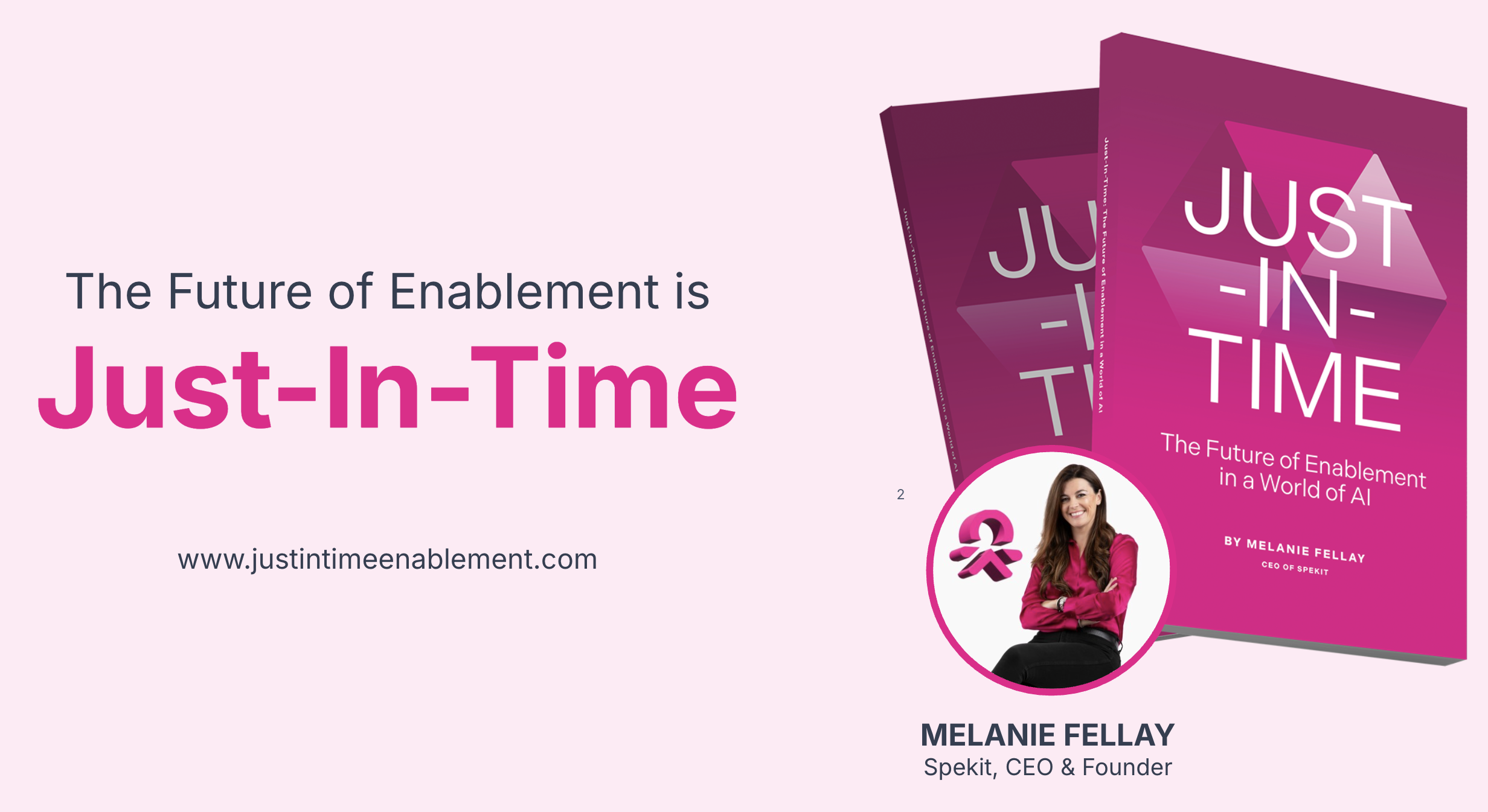
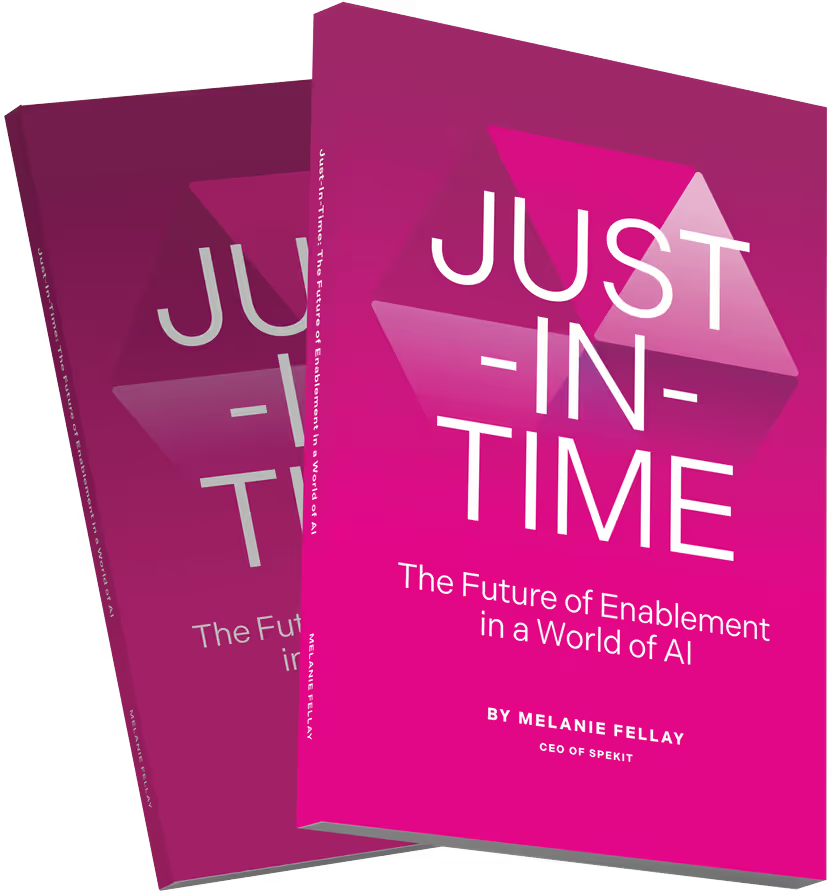
As Spekit CEO and Founder, Melanie Fellay, writes in her book Just-in-Time: Enablement in a World of AI, “Your reps aren’t lazy, they’re busy. Reps expect a consumer-grade experience.”
The best sales enablement platforms will respect that reality. They deliver the right nudge at the right time, inside the tools reps already use.
Not once at onboarding, but every day, in motion. The real gap isn’t volume of training or content. It’s access and application in the flow of work.
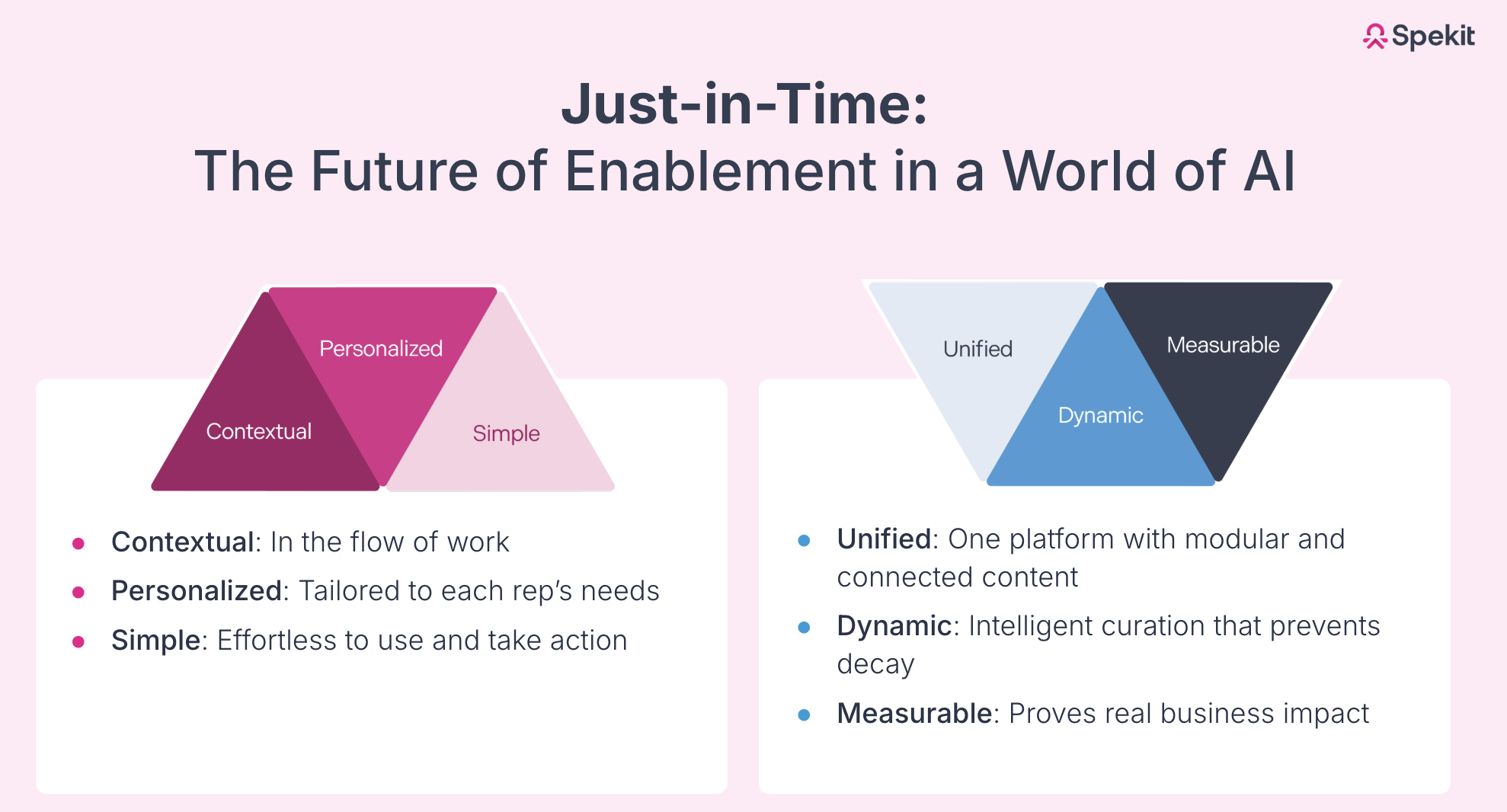
Modern sales enablement is contextual, personalized, simplified, unified, dynamic, and measurable. Here's what we mean by that:
Contextual: Guidance should adjust to the stage, account, and activity. If a rep is updating a Salesforce opportunity, they should see the two plays that matter for that stage and buyer, not a library. If they're drafting a follow-up, they should get the proof points and examples that fit the persona in front of them. Context trims cognitive load and increases action.
Personalized: One-size-fits-all is slow and forgettable. High performers need different coaching than new hires. A rep in healthcare needs different language than a rep in fintech. Personalization uses signals from CRM, calls, email, and past performance to recommend what will help this rep win this deal today.
Simplified: Fewer clicks, fewer tabs, and fewer places to look. Content, coaching, and workflows belong in one experience that is obvious to navigate. When the path to the answer is clear, adoption follows. When adoption follows, behavior changes.
Unified: Content lives once, not in six versions across six tools. Updates propagate everywhere. That single source of truth creates trust, saves time, and prevents the painful “which deck is current” dance that kills momentum.
Dynamic: Products, competitors, and messaging change weekly. Your system should change with them. Real-time nudges, everboarding playlists, and fresh talk tracks keep reps confident through constant change. Static playbooks cannot keep up.
Measurable: If you cannot see which content shows up in winning deals, you are guessing. Tie enablement to pipeline and revenue. Invest in what shows up in won deals and retire what doesn't.
This guide is about the stack, not just the platform. It covers one AI-first revenue enablement platform, Spekit®, and nine specialist tools that sit around it: conversation intelligence, sales engagement, interactive demos, deal rooms, AI practice, knowledge management, process documentation, and prospect data. If you are shortlisting full enablement platforms, read our 17 best sales enablement platforms comparison instead. Here, each tool was chosen for a distinct job, a current G2 rating of 4.5 or higher, and a clear way to connect with a governed enablement layer so guidance reaches reps where they work. What unites the strongest tools is the same set of principles: contextual, personalized, simplified, unified, dynamic, and measurable. Build around them and the governed library and the delivery layer become one system.
What is sales enablement software?
Sales enablement software is a tech platform that provides sales reps with the necessary resources, training, and coaching to improve their performance and close more deals.
Many legacy tools do less enabling and more knowledge dumping. Content piles up in an ungoverned repository with no versioning, conflict detection, or decay detection, so reps can't find it, don't trust it, and stop looking. A modern platform is different on both counts. It is a governed content library that keeps knowledge accurate, and it surfaces that knowledge in the flow of work.
Sales enablement software should be different. A good platform should deliver the right knowledge, tools, and guidance exactly when reps need it — whether they’re prepping for a big meeting, handling a tough objection, or trying to move a deal across the finish line.
Common features of sales enablement tools include:
- Content management: They offer a centralized library where reps can access updated playbooks, case studies, presentations, and other materials to share with prospects.
- Coaching and training: They give sales reps access to training modules, sales playbooks, and templates to help them develop their skills.
- CRM integration: B2B sales enablement tools often sync with CRMs like HubSpot and Salesforce so that reps can manage customer information and access sales materials without switching between multiple tools.
- Sales analytics: They track how buyers engage with content and how reps perform against key metrics. These insights help sales teams identify what’s working, spot gaps, and continuously optimize sales strategies.
- AI guidance and content creation: Modern platforms use AI to recommend content, coach reps based on CRM and call signals, and generate approved, on-brand material from a governed source. This is now a core requirement, not a bonus.
- AI agent access: Newer platforms expose governed knowledge to AI assistants and agents through protocols such as MCP, so the answers a rep gets in Claude, ChatGPT, or Copilot match the answers in the CRM.
Benefits of sales enablement software
Here's how sales enablement tools can make a difference for your team:
1. Faster ramp for new hires
Structured Learning Paths built from the same governed content reps will use on the job replace ad hoc onboarding. New reps learn inside Salesforce and email rather than in a separate portal, and readiness is tracked so managers know who is ready for live deals. Scholastic reported 67% faster onboarding with this approach.
2. Answers and content in the flow of work
Reps get the right playbook, proof point, or next step inside the tool they are already using, prompted by the deal in front of them. Less time searching means more time selling. InMoment cut time spent searching for answers by 90%.
3. Content reps and buyers can trust
Governance features such as ownership, version history, decay detection, and single-source updates mean a pricing change or messaging update propagates everywhere it appears. Reps stop sharing outdated decks, and enablement stops chasing duplicates.
4. Personalized buyer experiences
Deal rooms and AI-generated follow-up let reps package the right content for each stakeholder and see who engaged with what. Buyers get a single place to evaluate; sellers get signals about where a deal stands.
5. Enablement tied to revenue
Content-to-revenue analytics show which assets, learning programs, and buyer interactions correlate with pipeline and closed-won deals, so leaders can fund what works.
6. One governed source for reps and AI agents
When the same governed knowledge powers rep guidance, buyer content, and AI assistants through MCP, every channel gives a consistent, approved answer. Teams avoid a second source of truth forming inside their AI tools.
Top picks overview: The 2026 sales enablement stack
Each tool below plays a distinct role. Spekit is the enablement platform; the rest are specialists that connect to it.
The 10 best sales enablement software tools for 2026
1. Spekit: AI-first revenue enablement platform
Spekit® is an AI-first revenue enablement platform built on a governed content library and GTM Knowledge Engine. Enablement and product marketing teams create content with AI Content Builder or sync it from Google Drive, SharePoint, Notion, and Confluence, then govern it with ownership, version history, role-based permissions, and similarity and decay detection. Spekit then delivers that knowledge as Enablement in the Flow of Work® through AI Sidekick, which works alongside reps in Salesforce, Gmail, Outlook, Gong, LinkedIn, Slack, Claude, and any browser-based tool.
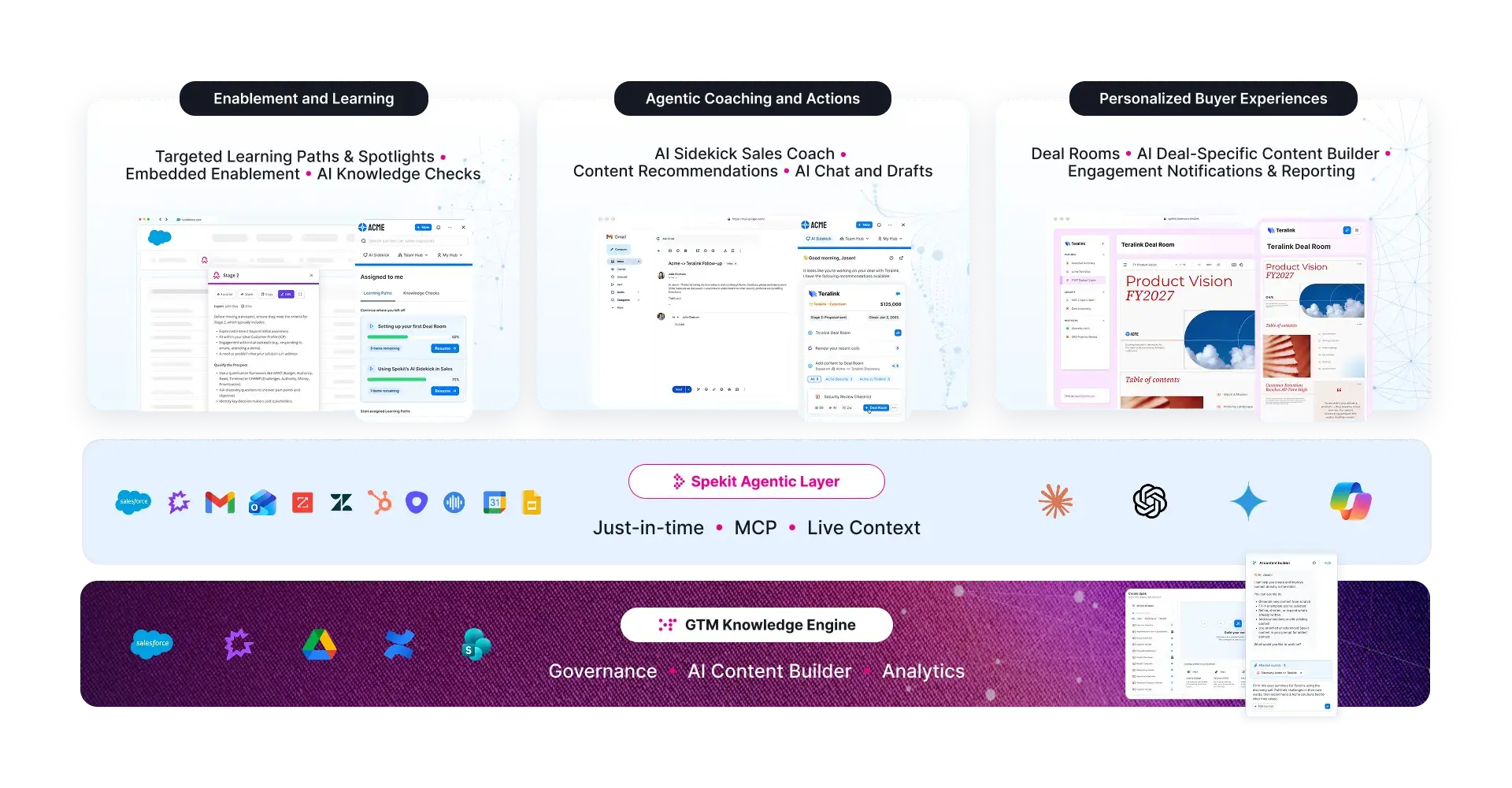
Unified Deal Context brings together signals from CRM, call intelligence, and email so every recommendation fits the deal in front of the rep. Because the same governed content powers guidance, training, Deal Rooms, and AI answers, a change made once in the GTM Knowledge Engine updates everywhere it appears.
Key capabilities:
- Governed content management: Central library with ownership, versioning, permissions, and built-in conflict and decay detection. Similarity detection flags overlapping content at creation so a second source of truth never gets published.
- AI Sidekick: Answers, recommended content, coaching, and next steps inside the rep's tools, grounded in approved knowledge and live deal context. Drafts follow-ups and builds Deal Rooms without leaving the workflow.
- Learning Paths and Knowledge Checks: Role-based programs assigned by team or automatically to new hires, delivered in-workflow. When source content changes, the path updates and re-engages reps.
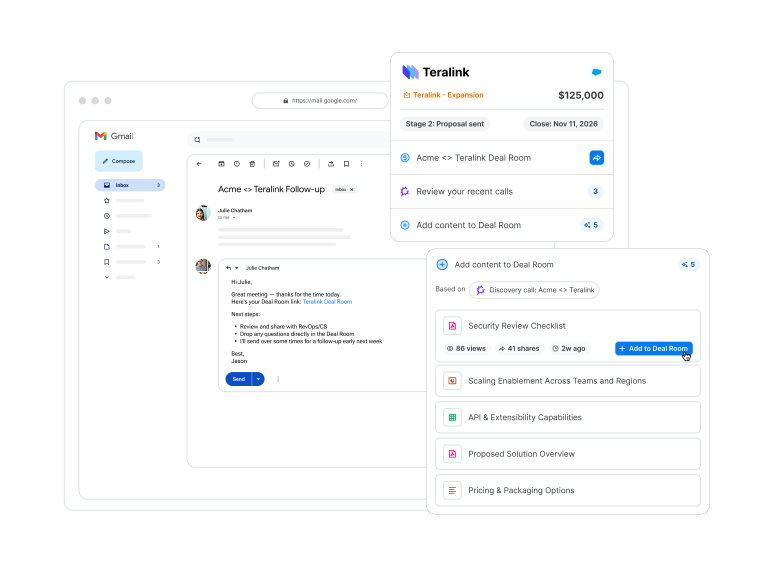
- AI Deal Rooms: Reps generate a personalized Deal Room in under 30 seconds from Gong and Salesforce context, with executive summaries and mutual action plans. Engagement tracking shows who opened what, and Slack alerts fire when key buyers are active.
- Analytics and Revenue Insights: Content engagement, learning progress, buyer engagement, and influenced pipeline and revenue in one place, with a governance dashboard for freshness and adoption.
- Spekit MCP: Connects the governed knowledge engine to Claude, ChatGPT, Gemini, Copilot, Glean, and custom agents, so AI tools answer from the same approved source as reps.
Best for: High-growth, mid-market, and enterprise B2B revenue teams in high-change environments that want one governed source of truth for every rep and every AI agent.
💡 Spekit is the hub of the stack below. Each specialist tool that follows either feeds Spekit with signals or receives governed content from it. InMoment's reps cut time spent searching for answers by 90% after moving to Spekit.
Notable alternatives: For a full comparison of enablement platforms, see 17 best sales enablement platforms and tools for 2026.
- Seismic: Enterprise content lifecycle, governance, and learning. Seismic completed its merger with Highspot on August 18, 2026; the combined company operates under the Seismic name.
- Showpad: Content, readiness, and buyer engagement for field-first sales organizations. Showpad and Bigtincan combined in October 2025.
- Mindtickle: Readiness, roleplay, coaching, content, and digital sales rooms with conversation intelligence.
Real customer quote: "I needed a piece of content and found it in seconds with Spekit. Before, it would've taken me hours, if I could even find it at all." - Anthony Panvini, Director of Enterprise New Logo | InMoment
2. Gong: Conversation intelligence for targeted coaching

Gong is a revenue AI platform that gives sales leaders and managers visibility into what’s happening on calls, demos, and meetings.
Instead of relying on secondhand updates or gut feelings, Gong records and analyzes every interaction, flagging risks, tracking key moments, and highlighting where deals or reps might need attention.
For example, sales leaders can open Gong and instantly see which deals are at risk, which reps are dominating calls instead of asking questions, or who’s struggling to handle a common competitor objection. This way, they know exactly who to coach, when to intervene, and how to replicate top-performer behaviors.
Key features:
- AI transcription and call scoring: Automatically transcribes calls and evaluates them for best practices, saving hours of manual review time.
- Deal risk alerts: Flags deals showing warning signs—like no next steps, weak engagement, or missed follow-ups—so managers can step in before it’s too late.
- Talk ratio and topic tracking: Analyzes who’s talking too much, who’s listening, and what key topics (like pricing or contract terms) are actually being discussed.
- Competitor and objection theme tracking: Surfaces trends in competitor mentions or objections across calls, helping sales and product teams stay proactive.
- Coaching scorecards: Lets sales managers give structured, targeted feedback based on real call performance, turning subjective coaching into a repeatable system.
In February 2026 Gong introduced Gong Enable, which adds structured lessons, an AI Trainer for practice conversations, and initiative tracking that links coaching programs to revenue outcomes. It extends Gong from analysis into coaching and practice; content management and in-workflow knowledge delivery remain outside its scope.
Best for: Mid-market and enterprise sales teams handling large pipelines or high call volumes, especially where frontline managers are stretched thin and need data to coach effectively at scale.
💡 Spekit integrates directly with Gong. Call signals feed AI Sidekick and Unified Deal Context, so the guidance a rep sees after a call reflects what the buyer actually said. After a Gong call, Spekit flags Deal Room content that may be out of date and recommends updates, and reps can generate a follow-up Deal Room from the transcript and Salesforce record in under 30 seconds.
Notable alternatives:
- Chorus (ZoomInfo): Conversation intelligence tied to ZoomInfo's data, best for teams already on ZoomInfo.
- Salesloft Conversation Intelligence: Formerly Clari Copilot, now part of the Salesloft unified brand.
- Avoma: Meeting notes and conversation analysis for cross-functional teams, less focused purely on sales.
3. Navattic: Unique buyer engagement via interactive product demos

Navattic helps companies create interactive, click-through product demos—no engineers or custom building needed.
Instead of requiring prospects to book a meeting just to see the product, Navattic allows them to watch a product demo first. This helps sales and marketing teams capture interest earlier, qualify buyers faster, and personalize follow-ups based on what the prospect actually explored.
For instance, if a prospect clicks on a Navattic interactive demo and spends the most time on a specific feature set, Navattic alerts reps about it. A rep can then follow up with a targeted case study about that feature set, making outreach smarter and way more effective.
Key features:
- No-code product tour builder: Build interactive product experiences without needing coding knowledge.
- Engagement analytics: Track how long prospects interact with demos, what steps they click on, and where they drop off.
- Demo templates by persona/use case: Quickly customize demos based on industry, role, or specific pain points, to increase relevance and engagement.
- CRM and marketing automation platform (MAP) integrations: Sync demo engagement data with your CRM or marketing platforms to trigger smarter workflows.
- Lead attribution from demo views: Connect demo activity back to lead records, helping teams understand which demo experiences drive pipeline.
Best for: SaaS, product-led growth (PLG), or consultative sales teams that want to scale buyer interest without scheduling more live demos or relying on heavy technical resources.
💡Spekit makes it easier for reps to act on Navattic demo insights. Teams can embed follow-up strategies, demo personalization tips, and next-step guidance directly into Salesforce, so reps always know how to tailor their outreach based on what prospects actually explored.
Notable alternatives:
- Consensus: Demo automation for enterprise buying groups, expanded through recent acquisitions.
- Storylane or Arcade: Lighter interactive demo builders popular with marketing teams.
- Reprise: Sandbox-style demo environments; requires more technical setup.
4. Dock
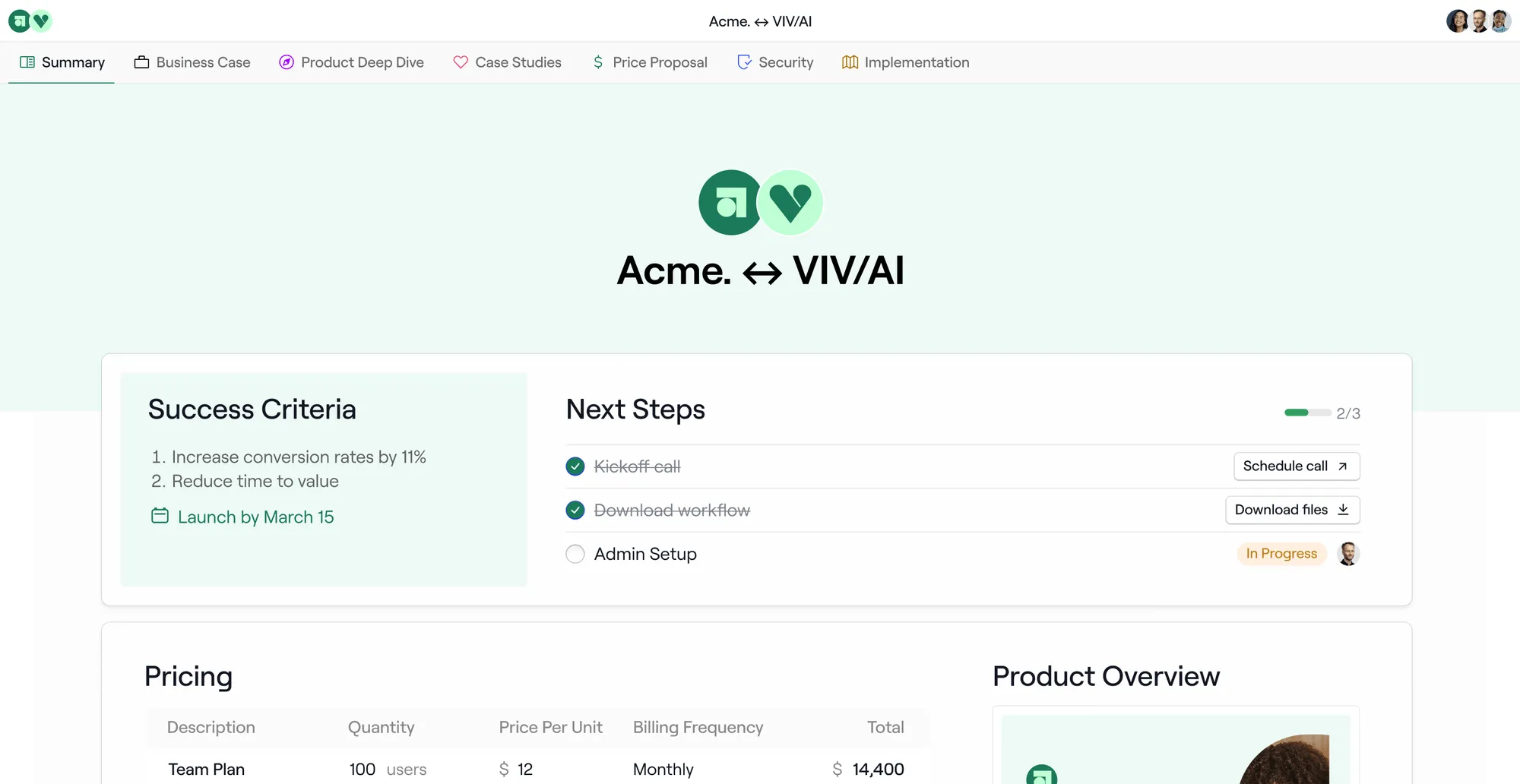
Dock is a digital sales room product that has expanded into revenue enablement. Its core object is a shared workspace: a branded page where a rep collects content, quotes, and a mutual action plan for one buying group, then carries the same workspace through onboarding and renewal. Around that, Dock has added a content library with tagging and search, AI-generated documents drawn from CRM and call data, an AI Enablement Agent that answers rep questions from Dock and CRM data, and Learning Playbooks, which are internal workspaces used for training.
For a rep, Dock is a destination. The workspace is where follow-up gets standardized and where a champion can share the evaluation internally. Engagement data from those workspaces feeds back to the seller.
Key features:
- Deal rooms: Shareable workspaces combining content, AI-generated documents, quotes, and mutual action plans.
- AI Documents: Business cases, executive summaries, and action plans generated from CRM fields and call transcripts.
- Content library: Tagging, AI search, and asset performance analytics.
- AI Enablement Agent: Chat-based answers based on Dock and CRM data.
- Learning Playbooks: Internal workspaces used for lightweight training.
- Lifecycle workspaces: The same workspace persists from sales through onboarding and renewal.
Best for: Mid-market revenue teams whose main problem is buyer-facing follow-up and handoffs across sales, onboarding, and customer success.
What to evaluate: Dock's content management and learning features live inside Dock. Ask how content ownership, versioning, and expiry are governed, whether guidance reaches reps inside Salesforce, Gmail, or Gong rather than in the Dock workspace, and how training stays current when source content changes.
💡 Dock and Spekit both offer deal rooms, so most teams pick one. Dock suits teams that want a buyer workspace spanning the customer lifecycle. Spekit suits teams that want AI Deal Rooms generated from governed content and live deal context, alongside rep guidance, learning, and analytics in the same platform, with content that updates in every room when the source changes.
Notable alternatives:
- Spekit: AI Deal Rooms generated from Gong and Salesforce context, plus governed content, in-workflow guidance, and learning in one platform.
- Seismic: Enterprise enablement with content, learning, and digital sales rooms; completed its merger with Highspot in August 2026.
- Trumpet: Dedicated digital sales rooms with mutual action plans (see entry 10).
5. Salesloft: Sales engagement and revenue orchestration
Salesloft is a revenue orchestration platform that combines sales engagement, conversation intelligence, deal management, and forecasting. Salesloft and Clari completed their merger on December 3, 2025, and unified under the Salesloft brand on September 2, 2026. Clari Forecast keeps the Clari name; conversation intelligence, formerly Clari Copilot, now ships as Salesloft Conversation Intelligence.
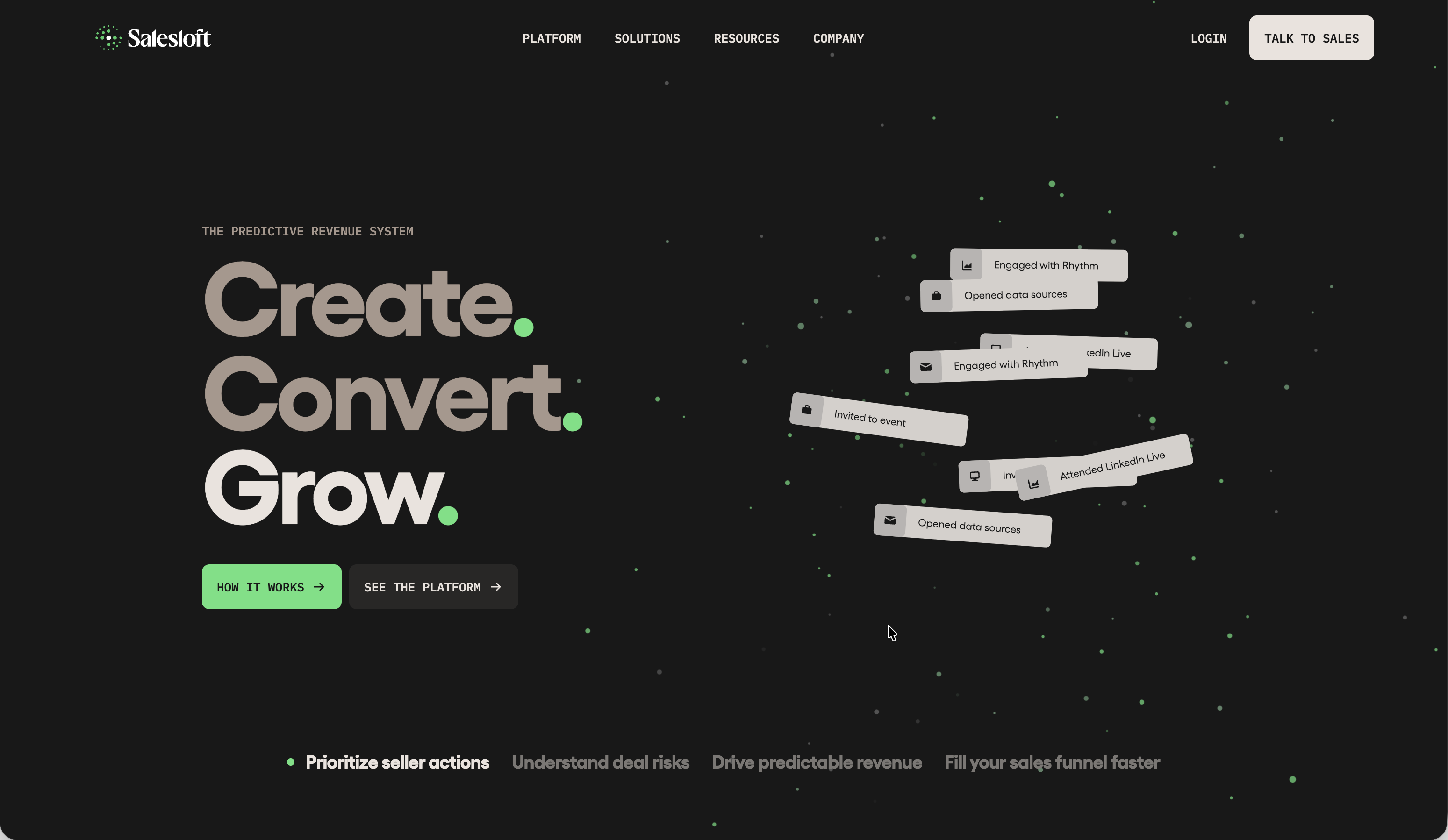
For reps, Salesloft is where outbound and follow-up work happens: multi-step cadences across email, phone, and LinkedIn, prioritized by AI signals about which accounts and deals need attention now.
Key features:
- Cadences: Multi-channel sequences for prospecting and follow-up, with templates and A/B testing.
- Rhythm: AI-prioritized daily workflow that surfaces the next best action from buyer signals across email, calls, and CRM.
- Conversation Intelligence: Call recording, summaries, real-time battlecards, and automated CRM updates.
- Deals and Forecast: Pipeline inspection and forecasting from the Clari side of the merger.
- CRM integration: Native Salesforce and HubSpot sync.
Best for: Mid-market and enterprise sales teams that want prospecting, conversation intelligence, and forecasting in one system.
💡 Salesloft runs in the browser, so AI Sidekick works inside it. Reps drafting a cadence step see the approved messaging, persona talk track, or objection response for that account without switching tabs, and governed content shared from Spekit stays current if it changes later.
Notable alternatives:
- Outreach.ai: Sales execution with AI agents and an agentic workflow layer (Outreach Omni).
- Apollo: Prospect data and sequences in one tool, popular with smaller teams.
- Gong Engage: Sales engagement inside the Gong platform for teams already on Gong.
6. Second Nature: AI roleplay and practice

Second Nature is a sales training platform that uses AI avatars to simulate real buyer conversations. It gives reps a safe, structured way to practice objection handling, discovery, and messaging delivery.
Instead of relying solely on expensive in-person role plays or inconsistent peer feedback, reps can practice anytime, get immediate scoring, and continuously improve their sales performance before going live with customers.
For example, before a major product launch, sales leadership could require reps to pass a mock conversation with an AI CFO inside Second Nature. The platform would automatically grade each rep’s tone, content, and clarity, and only those who meet certification standards can pitch the new messaging live. This ensures that reps are truly ready, not just "trained."
Key features:
- AI-based roleplay partners: Provide realistic buyer simulations 24/7, allowing reps to practice in a low-pressure, scalable environment.
- Pitch scoring and coaching feedback: Automatically grade reps based on tone, key messaging points, and conversation flow, giving immediate, actionable feedback.
- Customizable scenario libraries: Build and customize a wide range of scenarios, like discovery calls, objection handling, or negotiation practice, to match real-world situations.
- Manager review dashboards: Enable managers to review scores, track progress, and prioritize coaching based on actual practice data.
- LMS and CRM integrations: Sync certifications and practice results into learning systems or CRMs to keep rep records updated without extra administrative work.
Best for: Enablement teams supporting global sales reps, or companies that are launching new products, entering new markets, or onboarding at scale.
💡Spekit reinforces what reps practice in Second Nature by embedding objection handling tips, certified pitch templates, and key messaging directly into Gmail, Salesforce, Salesloft, or wherever the objection comes up. Once reps pass certification, Spekit keeps those talking points within reach during live conversations.
Notable alternatives:
- Gong Enable (AI Trainer): Roleplay built on real call data for teams already on Gong; launched February 2026.
- Allego and SalesHood: Broader enablement platforms that include practice and coaching modules; evaluate simulation depth directly.
- Mindtickle: Readiness platform with AI roleplay as one component.
7. Guru: Knowledge management

Guru is a company wiki and knowledge base built around short, verifiable "cards." Subject-matter experts own cards and re-verify them on a schedule, and employees retrieve them through a browser extension, Slack, and Microsoft Teams. In 2026 Guru added Knowledge Agents that answer questions in chat from verified cards and connected sources, and an MCP integration for Slack.
Guru is designed for information that many departments share: HR policy, IT procedures, support escalation steps, and internal FAQs. A rep who forgets a contract approval process can ask the Guru bot in Slack and get the current card.
Key features:
- Verified cards: Owners re-verify content on a set cadence, and unverified cards are flagged.
- Browser extension and chat integrations: Retrieval in Chrome, Slack, and Microsoft Teams.
- Knowledge Agents: AI answers from verified cards and connected sources, with follow-up in Slack threads.
- Knowledge alerts: Push updates to specific groups when a card changes.
- Usage analytics: Which cards are used, searched for, and missing.
Best for: Cross-functional organizations that need one internal wiki for support, operations, HR, and IT, with verification discipline.
What to evaluate: Guru manages text-based knowledge cards. Ask how it handles GTM content such as decks, one-pagers, and battlecards, whether guidance can be tied to a Salesforce field or a deal stage, and how it supports structured training and buyer-facing sharing.
💡 Guru and Spekit are both knowledge platforms, built for different jobs. Guru is a cross-functional company wiki for support, operations, and HR. Spekit is a governed GTM knowledge base and content library that also delivers that knowledge as Enablement in the Flow of Work® inside Salesforce, email, Gong, Slack, and AI tools through MCP. Teams that use both typically keep company-wide policy in Guru and GTM content, playbooks, and training in Spekit. Teams choosing one for revenue enablement should start with where reps need answers: if the answer has to arrive inside the deal workflow, Spekit is the more direct fit.
Notable alternatives:
- Confluence: Flexible documentation and team collaboration with Rovo AI; general purpose rather than enablement-specific.
- Notion: Highly customizable workspace; governance for sales content requires manual structure.
- Glean: Enterprise search across connected apps, best for large organizations with many systems.
8. Scribe: Process documentation

Scribe is a documentation tool that automatically generates visual, step-by-step guides from screen recordings. Instead of manually writing out instructions or taking endless screenshots, teams can create polished process documentation in minutes, saving hours of time.
For example, a sales operations lead could record themselves updating a lead record in Salesforce. As they click through the workflow, Scribe automatically captures each step, adds screenshots, and generates a clean guide. That guide can then be linked inside a Spekit card, making it instantly accessible to the sales team right where they work.
Key features:
- Auto-capture workflows: Record a task once and automatically generate a step-by-step guide without any manual formatting.
- Screenshots and editable steps: Automatically includes screenshots with the ability to edit text, highlight clicks, and adjust instructions as needed.
- Chrome extension: Capture processes directly from your browser with a simple click, making it easy to document CRM workflows, support tools, and more.
- Shareable links or embeds: Instantly share guides via links or embed them inside wikis, emails, or enablement tools like Spekit.
- Workspace permissions: Manage who can create, edit, and view guides to maintain control and governance over documentation.
Best for: Operations, enablement, and support teams that frequently need to document internal tools and systems for onboarding, training, handoffs, or change management.
💡Scribe captures the process once. Spekit delivers those processes contextually, surfacing the right workflow exactly where reps or employees need to apply it.
Notable alternatives:
- Tango: Offers similar auto-capture functionality but tends to lean more toward individual, consumer-focused use cases.
- Loom: Great for recording videos but less efficient for creating structured, step-based written guides.
- Notion: Highly flexible, but documentation in Notion requires manual formatting and is harder to standardize across fast-moving teams.
9. Clay: Prospect intelligence

Clay is a prospecting and data enrichment platform that helps sales teams personalize outreach at scale without getting bogged down in manual research. Clay automatically pulls prospect data from over 50 sources (including LinkedIn, company news pages, and websites), detects key buying signals, and builds workflows that surface the right leads at the right time.
For example, SDRs can set up a workflow in Clay to find leads who recently changed roles. Clay enriches each profile with social media posts, job descriptions, and recent news, enabling the SDR to personalize outreach in just one click. Instead of researching every prospect manually, reps spend more time connecting and less time digging.
Key features:
- Multi-source enrichment: Automatically pulls and consolidates prospect data from over 50 different sources into a single view.
- Buying signal detection: Flags critical events like new hires, fundraising rounds, product launches, and other buying triggers, so reps can prioritize hot leads.
- Workflow logic: Automate lead filtering, enrichment, and scoring with flexible, no-code workflows tailored to your prospecting strategy.
- AI-assisted personalization: Generate dynamic, context-driven messaging suggestions based on enriched prospect data to speed up custom outreach.
- CRM and email integrations: Seamlessly push enriched leads and personalized messages into your CRM or sales engagement platforms for immediate action.
Best for: Outbound sales teams that need to balance high-volume outreach with high-context personalization.
💡 Clay helps reps find the “who” and “why” behind outreach. Spekit steps in to guide the “how” by surfacing messaging frameworks, persona-specific playbooks, and tailored value props inside the CRM as reps move from lead identification to engagement.
Notable alternatives:
- Apollo: Strong for building prospect lists and running outbound campaigns.
- ZoomInfo: A market leader for robust contact databases, though it’s less customizable.
- Cognism: Specializes in GDPR-compliant data enrichment, making it a strong choice for teams focused on European markets.
10. Trumpet: Digital Sales Room (DSR)

Trumpet is a dedicated digital sales room vendor. Reps build a branded microsite, which Trumpet calls a "pod," for each deal, then add recap notes, pricing options, contracts, videos, and a mutual action plan. Buyers and additional stakeholders such as legal or procurement join the pod instead of receiving a chain of attachments, and reps see who viewed what and when.
Trumpet's scope is the buyer-facing room. Content is uploaded or linked into each pod, and the seller assembles it.
Key features:
- Branded pods: Custom-branded spaces for each deal, from first meeting through close.
- Mutual action plans: Shared timelines and tasks visible to buyer and seller.
- Engagement tracking: Views, time on content, and return visits by stakeholder.
- Integrations: CRM, calendar, and video tools.
- Commenting: Internal and buyer-facing comments inside the pod.
Best for: Sales teams running multi-stakeholder deals who want a standalone digital sales room with strong mutual action plan features.
What to evaluate: Trumpet does not govern the content that goes into a pod. Ask where approved content lives, how a pod is updated when pricing or messaging changes, and how much manual assembly each pod requires.
💡 If Spekit is already in your stack, evaluate whether you need a separate digital sales room. Reps can generate a personalized AI Deal Room in under 30 seconds from Gong and Salesforce context, with governed content that updates automatically and engagement signals delivered to Slack. Trumpet remains a strong choice for teams that want a dedicated DSR vendor with deep mutual action plan features.
Notable alternatives:
- Spekit: AI Deal Rooms generated from deal context and governed content, inside the enablement platform.
- DealHub: Digital sales rooms connected to CPQ (configure, price, quote) workflows.
- Dock: Buyer workspaces with templates that persist from sales through onboarding and renewal.
- Aligned: Collaborative deal workspaces with a simple, structured layout.
Translate bottlenecks into buying criteria
Anchor every requirement to the six principles from Just-in-Time: Enablement in a World of AI:
Match problems to capabilities in the flow of work
- “I forget steps mid-task.” Use just-in-time guidance that pops up inside the workflow and nudges at the exact step.
- “Coaching isn’t sticking.” Reinforce with bite-size, contextual nudges after calls and before next steps, not in long courses.
- “Content goes unused.” Deliver the single, most relevant proof point in-app based on role, stage, and buyer context. Think an AI sidekick that whispers “use this case study instead.”
Make it measurable and sustainable
Organizations that adopt just-in-time learning are significantly more likely to exceed seller revenue and customer retention targets. Build your selection around the ability to attribute content and coaching to outcomes, not clicks.
Pro tip from the book: AI needs good fuel. Incentivize CRM and pipeline hygiene so recommendations stay accurate and trusted. Even the smartest model can’t fix dirty data.
You don’t need a bigger stack. You need a system that removes friction and recommends the next right move at the moment of need. That’s how enablement becomes a quiet advantage reps rely on, not noise they ignore.
Next steps
- Learn more about just-in-time enablement here or get a copy of the book by clicking below.
- Learn how to measure sales enablement success here.