



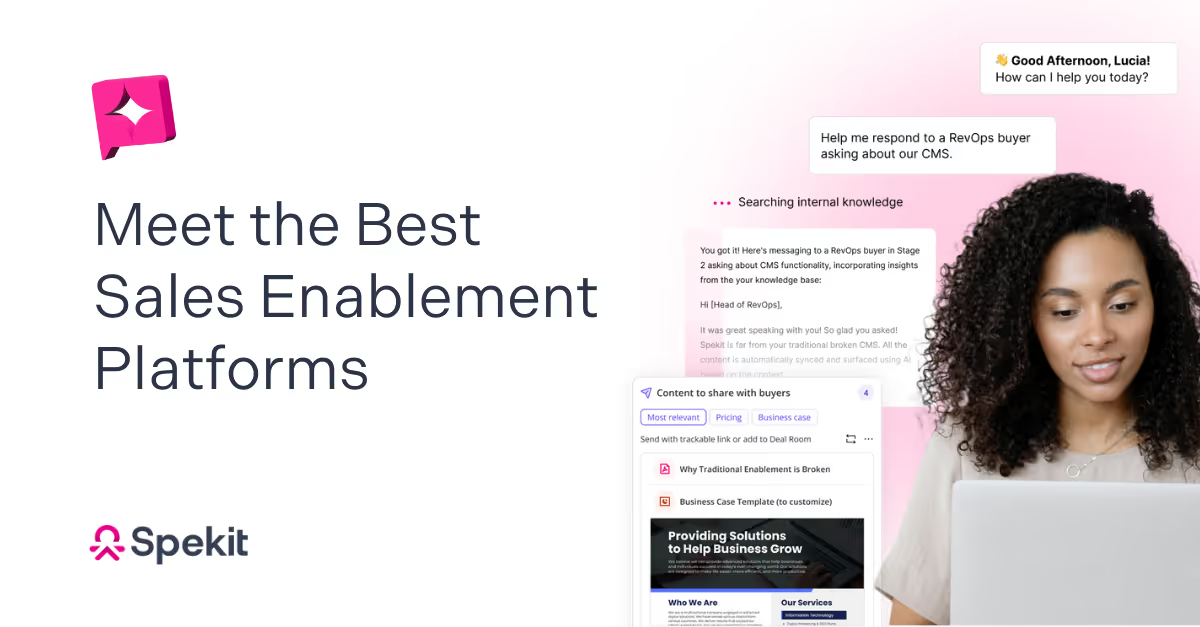
Sales enablement is the strategy and practice of giving sellers the knowledge, content, skills, guidance, and technology to engage buyers and move deals forward. A sales enablement platform operationalizes that strategy: managing resources, supporting learning, delivering guidance, and measuring business impact.
The best sales enablement platform for 2026 is Spekit® for high-growth, mid-market, and enterprise B2B revenue teams that want one governed system for content, learning, workflow guidance, buyer experiences, analytics, and AI. Spekit is an AI-first revenue enablement platform built on a governed content library and GTM Knowledge Engine. It is designed around rep adoption: AI Sidekick, the rep's AI sales coach, delivers Enablement in the Flow of Work® by surfacing trusted answers, relevant content, coaching, and next actions inside the tools sellers already use.
Other products may be a better fit when the requirement is a narrow point solution, such as formal sales readiness, field selling, value selling, or a standalone digital sales room.
The products in this guide do not all solve the same problem. Seismic and Highspot are legacy portal-based suites. Mindtickle, Allego, and SalesHood are centered on formal learning and readiness. Showpad and Pitcher specialize in field enablement, while products such as Gong, Guru, and Klue address individual parts of the enablement stack. Spekit ranks first because it combines the governed foundation of a full enablement platform with an adoption model built around how reps actually work.
The best sales enablement platforms and tools at a glance
Compare the top sales enablement platforms
The table below applies the same five fields to every platform in this guide, plus a Salesforce integration column since it is one of the most common requirements buyers bring to this decision.
| Platform | Primary category | Best fit | Principal strength | Important tradeoff or question | Salesforce integration | Tag |
|---|---|---|---|---|---|---|
| Spekit | AI-first revenue enablement | High-growth, mid-market, and enterprise B2B revenue teams | Governed content and learning connected to in-workflow coaching, deal context, buyer experiences, analytics, and AI | A narrower specialist may be sufficient when the need is one isolated function | Native: guidance, coaching, and Deal Rooms surface directly inside Salesforce workflows | BEST OVERALL |
| Seismic | Legacy enterprise content portal | Large enterprises with a dedicated enablement operations team | Broad content, learning, coaching, and analytics accumulated over time | Larger implementation and administration; roadmap overlap with Highspot after the merger | Connects Seismic to Salesforce, Agentforce, and Slack, spanning Experience Cloud, Financial Services Cloud, and Salesforce Libraries | MERGED WITH HIGHSPOT |
| Highspot | Legacy revenue enablement portal | Enterprises already standardized on Highspot's content and play library | Central content library combined with plays, training, and coaching | Now an overlapping product from the same supplier as Seismic; confirm the combined roadmap before renewing | Covers Sales Cloud, Agentforce, and Sales Programs; auto-relates buyer engagement to Salesforce records | MERGED INTO SEISMIC |
| Showpad | Field sales enablement | Field and in-person selling teams needing mobile content | Mobile content access and interactive product presentations | Less suited to CRM, email, and browser-centered workflows | Lightning-ready app that automatically logs field and buyer interactions into Salesforce | |
| Mindtickle | Sales learning and readiness | Teams centering enablement on formal training and certification | Training, practice, certification, coaching, and skill measurement | Value depends on a formal program and continued manager participation | Content and training surface inside Salesforce, with user provisioning and automatic opportunity-field updates | |
| Allego | Learning and conversation-based coaching | Teams that want coaching built from recorded sales calls | Learning, practice, and manager coaching tied to conversation analysis | Adoption depends on participation in training and coaching programs | Embeds learning, content, coaching, and Digital Rooms inside the CRM and ties engagement activity to opportunity records | |
| SalesHood | Formal enablement programs | Teams running structured onboarding, certification, and peer learning | Onboarding, certification, coaching, and role-practice programs | Program completion does not guarantee adoption during live selling | Recommends content inside the tools sellers already use, including Salesforce, Microsoft, and Gmail | |
| Mediafly | Value-selling tools | Complex enterprise sales needing ROI and business-case tools | ROI calculators, TCO models, and business-case development | Requires building and maintaining the underlying models; covers one part of enablement | Appinium, its Salesforce-native LMS and content hub, runs learning and coaching inside Salesforce against Contact, Account, and Opportunity records | |
| Pitcher | Mobile field enablement | Field teams needing offline and mobile access | Mobile, offline content access and guided customer meetings | Built for in-person and offline use, not browser-based daily workflows | Lists Salesforce among its CRM integrations, capturing field interactions and updating records | |
| GTM Buddy | Revenue activation | Teams wanting recommendations delivered inside seller workflows | Content and recommendations delivered in-workflow | Positioning increasingly overlaps Spekit; compare content governance and adoption depth directly | Salesforce-native app: AI content recommendations keyed to opportunity context, plus email, contact, and note capture from the CRM | |
| Dock | Buyer and customer workspaces | Teams wanting a shared destination for buyer collaboration | Content, mutual action plans, onboarding tasks, and deal activity in one workspace | Content library, playbooks, and courses sit inside a deal-room-first product; compare governance depth and in-CRM delivery directly | Syncs accounts, opportunities, and order forms and pushes room activity back to Salesforce; the workspace itself lives outside the CRM | |
| Paperflite | Content activation | Teams wanting to organize, share, and track existing content | Content activation and buyer-engagement tracking | Not designed to own the full enablement lifecycle | Runs a full Paperflite instance inside Salesforce to manage, share, and track content without leaving the CRM | |
| Mutiny | Deal-specific content generation | Teams needing content generated on demand from account and CRM context | Generates personalized buyer-facing assets from deal context | Does not govern an existing content library or manage the seller-enablement lifecycle | Lists Salesforce among its integrations, pulling CRM context to generate work and writing updates back | |
| GetAccept | Deal rooms and transactions | Teams wanting proposals, contracts, and e-signatures in one flow | Digital sales rooms connected to proposals, pricing, and signatures | Internal knowledge, learning, and coaching remain another platform's job | Create, share, and track proposals and contracts without leaving the CRM, with sync back to Salesforce | |
| Guru | Company-wide knowledge management | Cross-department teams needing verified-answer search | Horizontal knowledge management and AI search | Not organized specifically around the revenue lifecycle | Delivers AI-powered answer search inside Salesforce through Guru's browser extension | |
| Gong | Conversation intelligence | Teams wanting signals from recorded calls | Identifies deal risk, objections, competitive mentions, and coaching moments from conversations | Does not govern the content and knowledge sellers should use | Captures and transcribes calls, then feeds activity and deal-risk signals into Salesforce for pipeline tracking | |
| Klue | Competitive intelligence | Teams building battlecards and win-loss analysis | Turns competitive signals into battlecards and deal guidance | Covers one domain of enablement, not the broader knowledge and adoption stack | Battlecards accessible from any Salesforce object, with win-loss data captured back in the CRM |
What should a modern sales enablement platform do?
A governed content library remains the foundation of effective sales enablement. Revenue teams need one place to create, synchronize, organize, approve, update, and measure the content and knowledge sellers rely on.
Modern sales enablement extends that foundation into execution. The platform should not force a choice between managing content and delivering it at the moment of need. It should do both: keep GTM knowledge current and make it easy for reps to apply through learning, contextual guidance, deal actions, buyer experiences, and AI.
A modern sales enablement platform should connect six capabilities:
- Native content creation, management, and governance: Create and manage content inside the platform, synchronize existing repositories, and establish clear ownership, permissions, approvals, versions, reviews, and retirement processes.
- Rep adoption and in-workflow support: Surface trusted answers, content, coaching, drafting help, and next actions inside CRM, email, call, collaboration, and browser workflows rather than relying on sellers to visit another portal.
- Deal context: Use opportunity data, conversations, email context, and buyer activity to make recommendations relevant to the active deal.
- Continuous learning and reinforcement: Support onboarding, AI role plays, knowledge checks, and everboarding while reinforcing knowledge when sellers must apply it.
- Personalized buyer experiences: Help sellers create and share approved, relevant content for the people, stage, and context of an opportunity.
- Revenue visibility: Connect content, guidance, learning, adoption, and buyer engagement to opportunities and business outcomes.
AI should strengthen each of these capabilities rather than sit beside them as a disconnected feature. It is only as useful as the knowledge, permissions, ownership, and freshness controls behind it.
These criteria separate a full sales enablement platform from an adjacent tool. A wiki can store knowledge. A conversation-intelligence platform can analyze calls. A competitive-intelligence tool can build battlecards. A digital sales room can organize a buyer interaction. Each can support enablement, but none automatically becomes the system responsible for connecting trusted GTM knowledge to seller and buyer execution.
Who this ranking is for
The right sales enablement platform depends on team size, motion, and where sellers actually work. The capabilities above, in that order, are the criteria behind this ranking, reviewed against current product pages, integration pages, customer evidence, and corporate announcements through September 18, 2026. Use these tests to place your team before reading the entries below.
- Enterprise teams: Test governance at scale, including role-based permissions, approval workflows, and administration across thousands of sellers and multiple business units.
- Mid-market teams: Test time to value and the ongoing administrative load relative to the size of the team maintaining the platform.
- SaaS companies: Test how quickly content and learning update when product, pricing, or positioning changes, since SaaS motions tend to move faster than most enablement content libraries.
- Remote and distributed sales teams: Test whether guidance and coaching reach sellers inside the tools they already use, such as CRM, email, call, and chat, rather than requiring a trip to a separate portal.
Full sales and revenue enablement platforms
These are full sales and revenue enablement platforms: systems built to govern GTM content and deliver it through learning, coaching, buyer experiences, and analytics across an entire revenue team, not a single sales function.
1. Spekit: Best overall sales enablement platform
Spekit® is an AI-first revenue enablement platform for high-growth, mid-market, and enterprise B2B revenue teams. Built on a governed content library and GTM Knowledge Engine, it unifies AI-powered content creation, content management, learning, governance, coaching, digital sales rooms, and analytics. AI Sidekick, the rep's AI sales coach, delivers Enablement in the Flow of Work® through approved content, contextual coaching, deal intelligence, and next-best actions inside the tools reps already use.
In the Spekit Content Hub, enablement and product marketing teams can create rep-ready content natively with AI Content Builder or synchronize existing assets from Google Drive, SharePoint, and Confluence. Ownership, version history, approvals, role-based permissions, freshness controls, and similarity and decay detection help teams keep product information, messaging, processes, playbooks, competitive guidance, and buyer-facing content accurate.
Because the same living content powers guidance, learning, buyer experiences, and answers, teams get content management, learning management, knowledge management, and digital adoption capabilities from one system rather than separate disconnected tools.
Best fit: High-growth, mid-market, and enterprise B2B revenue teams operating in high-change environments that want one governed platform for content, learning, deal support, seller guidance, buyer experiences, analytics, AI, and rep adoption.
2. Seismic: Legacy enterprise content portal
Merger update: On August 18, 2026, Seismic completed the transaction to merge with Highspot. No roadmap has been announced. Buyers should carefully consider the impact such a large acquisition will have on product, support, vision and roadmap for the combined products. Learn more.
Seismic is a legacy portal-based enablement suite built around managing and distributing enterprise sales content. It has accumulated learning, coaching, analytics, and AI capabilities, but that breadth can require a larger implementation, more administration, and greater challenges with rep adoption. Its merger with Highspot also creates product-overlap and roadmap questions for buyers.
Buyers usually consider Seismic when a large, distributed sales organization needs one governed library for enterprise content, automated personalization of documents at scale, and content analytics that marketing and enablement can act on. It is strongest where a dedicated enablement operations team can administer it. What to verify: the combined product roadmap and renewal terms after the Highspot transaction, and how much of the rep experience lives outside the portal.
3. Highspot: Legacy revenue enablement portal
Merger update: On August 18, 2026, Seismic completed the transaction to merge with Highspot. Highspot is no longer an independent company, unlike the other vendors in this list. The combined company operates under the Seismic name, with the Seismic CEO, and Seismic's main investor as primary shareholder. No roadmap for the product has been announced. Buyers should carefully evaluate contract terms, product and support commitments. Learn more.
Highspot is another legacy portal solution, combining a central content library with sales plays, training, and coaching. Although it offers workflow integrations, the Highspot environment remains the organizing center of the experience. It is now an overlapping product from the same supplier as Seismic, so buyers should clarify the long-term roadmap before treating it as an independent platform choice.
Highspot is typically shortlisted for its content library paired with sales plays, training, and coaching in one place, with recommendations delivered through its Salesforce and email integrations. Enterprises already standardized on its play structure value that continuity. What to verify: how the product roadmap, support commitments, and contract terms are affected now that Highspot operates under Seismic.
4. Showpad: Field sales enablement
Note: Bigtincan has been part of Showpad since October 2025, when Vector Capital combined the two companies under the Showpad brand. Evaluate them as one product line.
Showpad is primarily oriented toward field selling, mobile content access, and interactive product presentations. Its specialization is less relevant to teams whose sellers work mainly across CRM, email, call, and browser-based applications. Following its combination with Bigtincan, buyers should also confirm how previously separate products are being packaged and integrated.
Showpad is considered by field-heavy sales organizations, including manufacturing and life sciences, for mobile and offline content access, interactive presentations, and coaching tied to that content. It pairs a content library with learning modules for reps who sell in person. What to verify: how content recommendations reach reps who sell mainly from a CRM, email, and calls rather than a mobile device.
5. Mindtickle: Sales learning and readiness
Mindtickle is primarily a sales learning and readiness system. Its model centers on training, practice, certification, coaching, and measuring seller skills. That makes its value dependent on a formal readiness program and continued manager participation. It is less naturally positioned as the governed system for activating current GTM knowledge throughout a rep's daily workflow.
Mindtickle is chosen when readiness is the priority: onboarding paths, certifications, role-plays, and skill assessments that show managers where each rep stands. Conversation intelligence and coaching workflows connect that training to recorded calls. What to verify: how much manager time the program model requires, and how reps reach content or answers during live deal work rather than in a training session.
6. Allego: Learning and conversation-based coaching
Allego centers on learning, practice, manager coaching, and analysis of recorded sales conversations. Its primary adoption mechanism is participation in training and coaching programs. Teams whose larger problem is keeping GTM knowledge current and helping reps apply it during daily execution may still need a separate content and workflow-enablement layer.
Allego is shortlisted by teams that want learning, practice, and coaching built around video, with content sharing and conversation intelligence layered on the same platform. Its asynchronous video model suits distributed teams that cannot coach live. What to verify: how learning content stays current once programs are built, and how guidance reaches sellers inside CRM and email during daily work.
7. SalesHood: Formal enablement programs
SalesHood is designed around onboarding, certification, coaching, role practice, and peer learning. It helps enablement teams administer formal programs, but program participation does not automatically translate into adoption during live seller work. Teams should evaluate how effectively learning is reinforced after sellers leave the training environment.
SalesHood is considered for formal enablement programs: structured onboarding, certifications, pitch practice, and peer-to-peer learning that enablement teams can administer and measure. Digital sales rooms and content sharing extend the same platform to buyer interactions. What to verify: how program completion translates into behavior on live deals, and what reinforcement exists after a rep leaves the training environment.
8. Mediafly: Value-selling tools
Mediafly is most closely associated with value selling, including ROI calculators, TCO models, and business-case development. Those tools address an important part of complex enterprise selling, but they also require organizations to build, supply data for, and maintain the underlying models. Value selling represents one component of enablement rather than the complete knowledge and adoption lifecycle.
Mediafly is shortlisted when value selling is central to the motion: ROI and TCO calculators, business-case builders, and interactive presentations that quantify impact for a buyer, alongside content management and revenue intelligence. What to verify: who builds and maintains the value models over time, and how the rest of the enablement lifecycle, from onboarding to daily guidance, is covered.
9. Pitcher: Mobile field enablement
Pitcher is designed for field teams that need mobile and offline access, interactive content, and guided customer meetings. That architecture is specialized around in-person sales environments. Organizations without a substantial offline or field-selling requirement should assess whether they need a platform built around that operating model.
Pitcher is considered by field sales and life-sciences teams that need offline access, guided customer meetings on a tablet, and closed-loop marketing tied to CRM records. Its architecture is built around the in-person visit. What to verify: whether your sellers work mainly in person, and how the platform supports reps who spend their day in a browser-based CRM, email, and calls.
10. GTM Buddy: Revenue activation
GTM Buddy is a revenue activation platform positioned around content and recommendations delivered in seller workflows. Its expanding positioning now sounds similar to Spekit across several areas. Rather than comparing feature lists, buyers should examine the depth of its content governance, how knowledge is maintained and reused, and whether its workflow delivery produces sustained rep adoption.
GTM Buddy positions itself as revenue activation: content recommendations, in-the-moment guidance, and digital sales rooms delivered inside seller workflows, with AI drafting layered on top. Its positioning has broadened toward a full enablement platform. What to verify: the depth of its content governance, how knowledge is maintained and reused across surfaces, and evidence of sustained rep adoption.
Why Spekit ranks above the full-platform alternatives
The alternatives above are largely organized around a portal, a formal training program, or a specialized sales motion. Spekit is designed around rep adoption: teams govern content and knowledge centrally, while reps receive answers, learning, coaching, and buyer content inside the tools where they already work. Sellers do not have to remember to visit another destination before enablement can influence their behavior.
Spekit does not ask revenue teams to choose between a content management system and Enablement in the Flow of Work. It provides both: a modern, governed content library where teams create and maintain GTM knowledge, plus an activation layer that delivers that knowledge through coaching, learning, seller actions, buyer experiences, and AI.
Rep adoption is part of that architecture. Sellers can find what to say, get the right proof, prepare for a meeting, follow up, personalize buyer content, and complete the next action in Salesforce, Gmail, Outlook, Gong, Slack, LinkedIn, and other browser-based applications. The Spekit Content Hub remains the governed system behind every answer and asset, while sellers receive support without having to remember to visit another enablement portal.
Spekit activates that governed source through:
- AI Sidekick: An AI sales coach that provides approved answers, relevant content, contextual coaching, drafting, and next actions inside browser-based workflows.
- Unified Deal Context: Signals from Salesforce opportunities, Gong conversations, and email that make guidance relevant to the active deal.
- Personalized Buyer Experiences and Deal Rooms: Approved, on-brand content and buyer spaces adapted to the people, stage, and context of the opportunity.
- Learning and AI Role Plays: Learning Paths, Knowledge Checks, practice, and ongoing reinforcement built from the same maintained content used in daily work.
- Analytics: Visibility into content use, learning engagement, rep adoption, buyer activity, pipeline influence, and seller execution.
- Spekit MCP: Permission-aware access to content maintained in the Spekit Content Hub for connected AI assistants and agents.
Customer results.
Published customer outcomes include:
- 25% faster ramp at Employment Hero.
- 67% faster onboarding at Scholastic.
- 3x ROI in under 12 months at Q4.
Spekit was also named a Visionary in the 2025 Gartner® Magic Quadrant™ for Revenue Enablement Platforms.
Content activation and buyer-workflow tools
11. Dock: Buyer workspaces
Dock is primarily a buyer and customer workspace. It brings content, mutual action plans, onboarding tasks, and deal activity into a shared destination. It also adds a content library and courses, so verify how governance, learning, and delivery inside the CRM compare with a dedicated enablement platform.
Dock is used to give buyers and customers one shared workspace for a deal or an onboarding: content, mutual action plans, pricing, and tasks in a branded page with engagement tracking back to the CRM. It is quick to stand up and easy for buyers to use. What to verify: how content placed in a workspace stays current when source material changes, and what the team uses for internal knowledge and training.
12. Paperflite: Content activation
Paperflite helps teams organize, share, and measure existing sales and marketing content. Its focus is activating assets and tracking buyer engagement with them. It is not designed to own the complete enablement lifecycle across structured learning, contextual coaching, knowledge maintenance, and rep adoption.
Paperflite is shortlisted for content activation: organizing existing collateral, sharing it with buyers through trackable links and microsites, and reporting on which assets get engagement. It suits marketing and sales teams that want visibility into content use without a heavy platform. What to verify: how governance and versioning work for the library, and how reps receive guidance beyond content sharing.
13. Mutiny: Deal-specific content generation
Mutiny generates personalized buyer-facing assets from account, CRM, and conversation context. It solves the production problem that arises when a deal requires content that does not already exist. It does not serve as the primary system for governing an existing content library, maintaining structured learning, or managing the broader seller-enablement lifecycle.
Mutiny is considered by account-based teams that need personalized web experiences and deal-specific assets generated from account, CRM, and conversation data, so a rep can send a tailored page or microsite without waiting on marketing. What to verify: how generated assets are reviewed against approved messaging, and which system governs the source content they draw from.
14. GetAccept: Deal rooms and transactions
GetAccept connects digital sales rooms with proposals, pricing, contracts, and electronic signatures. Its responsibility is primarily buyer collaboration and deal completion. The internal knowledge, learning, coaching, and workflow adoption required to prepare sellers for those interactions generally remains the responsibility of another platform.
GetAccept is shortlisted for the closing stage: digital sales rooms that carry proposals, pricing, contracts, and electronic signature in one buyer-facing flow, with engagement tracking and CRM sync. It is strongest where deal completion, rather than enablement, is the bottleneck. What to verify: how the room's content is kept current before signature, and how sellers are trained and guided upstream of the proposal.
Why these tools do not replace a sales enablement platform
Dock, Paperflite, Mutiny, and GetAccept each address a particular content or buyer workflow. They can sit alongside an enablement platform, but none is responsible for connecting governed GTM knowledge, seller development, daily execution, and rep adoption across the complete revenue lifecycle.
Specialized enablement tools
15. Guru: Company-wide knowledge management
Guru is a horizontal knowledge-management and AI-search product used across departments. It can help sellers retrieve verified answers, but its scope is not specifically organized around the revenue lifecycle. Structured sales learning, deal guidance, buyer experiences, seller actions, and revenue measurement fall outside its primary role.
Guru is used as a company-wide knowledge layer: verified answers, AI search, and a browser extension that surfaces cards inside Slack, the CRM, and other tools for support, HR, IT, and sales alike. Its verification workflow keeps owners accountable for accuracy. What to verify: whether the revenue team also needs structured learning, deal-specific coaching, and buyer-facing content, which sit outside Guru's scope.
16. Gong: Conversation intelligence
Gong records and analyzes customer conversations to identify deal risks, objections, competitive mentions, and coaching opportunities. It is primarily a source of signals about what happened during seller and buyer interactions. It does not replace the governed content and knowledge system responsible for determining what sellers should know, say, share, and do next.
Gong is shortlisted for conversation intelligence: recording and analyzing calls and emails to surface deal risk, competitor mentions, objection patterns, and coaching moments, with forecasting built on the same signals. It is the system of record for what happened in customer conversations. What to verify: which platform turns those signals into approved guidance and content for the next conversation, since Gong reports on interactions rather than governing knowledge.
17. Klue: Competitive intelligence
Klue is a competitive-intelligence and win-loss platform. It turns competitive signals into battlecards, insights, and deal guidance. Competitive intelligence is one domain within enablement; it does not cover the broader product, process, messaging, learning, buyer-content, and rep-adoption requirements of a revenue team.
Klue is considered when competitive intelligence needs its own system: monitoring competitor moves, building and distributing battlecards, and win-loss analysis that feeds messaging back to sales and product marketing. What to verify: how battlecards reach reps inside the CRM or on a call, and how competitive content is kept consistent with the rest of the enablement library.
Why specialized tools complement rather than replace Spekit
Guru, Gong, and Klue contribute knowledge, conversation signals, or competitive intelligence to an enablement program. Spekit provides the broader governed environment that turns those inputs, and the rest of an organization's GTM knowledge, into guidance and action that reps adopt during daily work.
How to choose the right sales enablement platform
Start with the business failure you need to correct rather than the longest feature list.
- If sellers cannot find or trust content, test ownership, synchronization, freshness, search, and contextual delivery.
- If sellers are not using the enablement platform, test how much context switching it requires and whether support appears inside their normal workflows.
- If sellers know the playbook but do not apply it, test coaching and actions against real opportunities and workflows.
- If onboarding is slow, evaluate structured learning together with reinforcement after training ends.
- If buyers receive generic follow-up, test how quickly a seller can create an approved, relevant buyer experience from the active deal.
- If AI agents are being deployed, verify permissions, citations, ownership, source freshness, and traceability.
- If leaders cannot prove impact, test the connection between enablement activity, buyer engagement, pipeline, and closed revenue.
Run every finalist through the same practical evaluation:
- Import approved, duplicated, outdated, and permission-restricted content.
- Change an important piece of messaging and observe how quickly it updates everywhere.
- Ask a seller to answer a buyer question inside their normal workflow.
- Deliver coaching or learning tied to a live opportunity.
- Create and share a personalized buyer experience using approved content and deal context.
- Connect an AI assistant and inspect its permissions, citations, and source traceability.
- Produce a report linking content, rep adoption, or buyer engagement to pipeline.
- Price licenses, features, implementation, migration, integrations, services, and ongoing administration together.
The strongest platform is not necessarily the one with the most features. It is the one that turns trusted knowledge into better seller and buyer execution with the least friction, and that reps consistently adopt.
The bottom line
Modern enablement cannot stop at uploading content or delivering training. It must help sellers apply the right knowledge while they are preparing, communicating, following up, creating buyer content, and moving an opportunity forward.
Spekit ranks first because it combines the governed content foundation with an adoption-focused delivery layer. Teams can create, synchronize, manage, and measure GTM knowledge in Spekit, then use that same living content for learning, contextual coaching, seller actions, personalized buyer experiences, analytics, and AI. Reps receive that support inside the tools where they already work rather than having to remember to visit another enablement portal.
Frequently asked questions
What features matter most when choosing sales enablement software?
The features that matter most are native content governance, rep adoption inside the tools sellers already use, guidance tied to the active deal, connections between content and revenue outcomes, support for personalized buyer experiences, and permission-aware access for AI assistants. A platform can be strong in one area, such as content storage or formal training, and still fail to change what happens in a live deal.
What does it mean for a sales enablement platform to work inside a rep's workflow?
In-workflow delivery means guidance, content, and coaching appear inside the applications sellers already use, such as Salesforce, Gmail, Gong, and Slack, instead of requiring a visit to a separate enablement portal. It matters because content that lives only in a portal depends on sellers remembering to go look for it. Platforms differ in how much of their guidance is actually delivered this way versus surfaced only inside their own destination.
What is the best sales enablement platform for enterprise teams?
Enterprise teams need governance that holds up across thousands of sellers and multiple business units: role-based permissions, approval workflows, and administration at scale. Spekit and the legacy portal suites, Seismic and Highspot, all operate at this scale. The practical difference is implementation size, ongoing administration, and how much of the platform's guidance reaches sellers inside their daily workflow rather than inside a separate destination.
Which sales enablement platforms work well for SaaS companies?
SaaS companies change product, pricing, and positioning faster than most enablement content libraries can keep up with manually. The platforms best suited to that pace are the ones where updating a source document propagates the change everywhere it is reused, rather than requiring someone to find and edit every copy. Spekit is built around that model; buyers should test it directly against any shortlisted alternative using their own content.
What is the best sales enablement software for remote sales teams?
For remote and distributed teams, the deciding factor is whether guidance and coaching reach sellers inside the tools they already use, including CRM, email, call, and chat, rather than requiring them to travel to a separate portal that is easy to forget when no one is in the same office. Platforms built around in-workflow delivery, including Spekit, are designed for this; platforms centered on a destination portal or in-person field tools are a weaker fit for a fully remote motion.
Does a sales enablement platform need to integrate with Salesforce?
Most B2B revenue teams run their pipeline in Salesforce, so integration depth is worth testing directly rather than assuming from a vendor's integrations page. Spekit surfaces guidance, coaching, and Deal Rooms natively inside Salesforce records and workflows. Most other platforms in this guide also connect to Salesforce in some form; buyers should verify whether that connection is a native, in-record experience or a separate destination that syncs data back and forth.